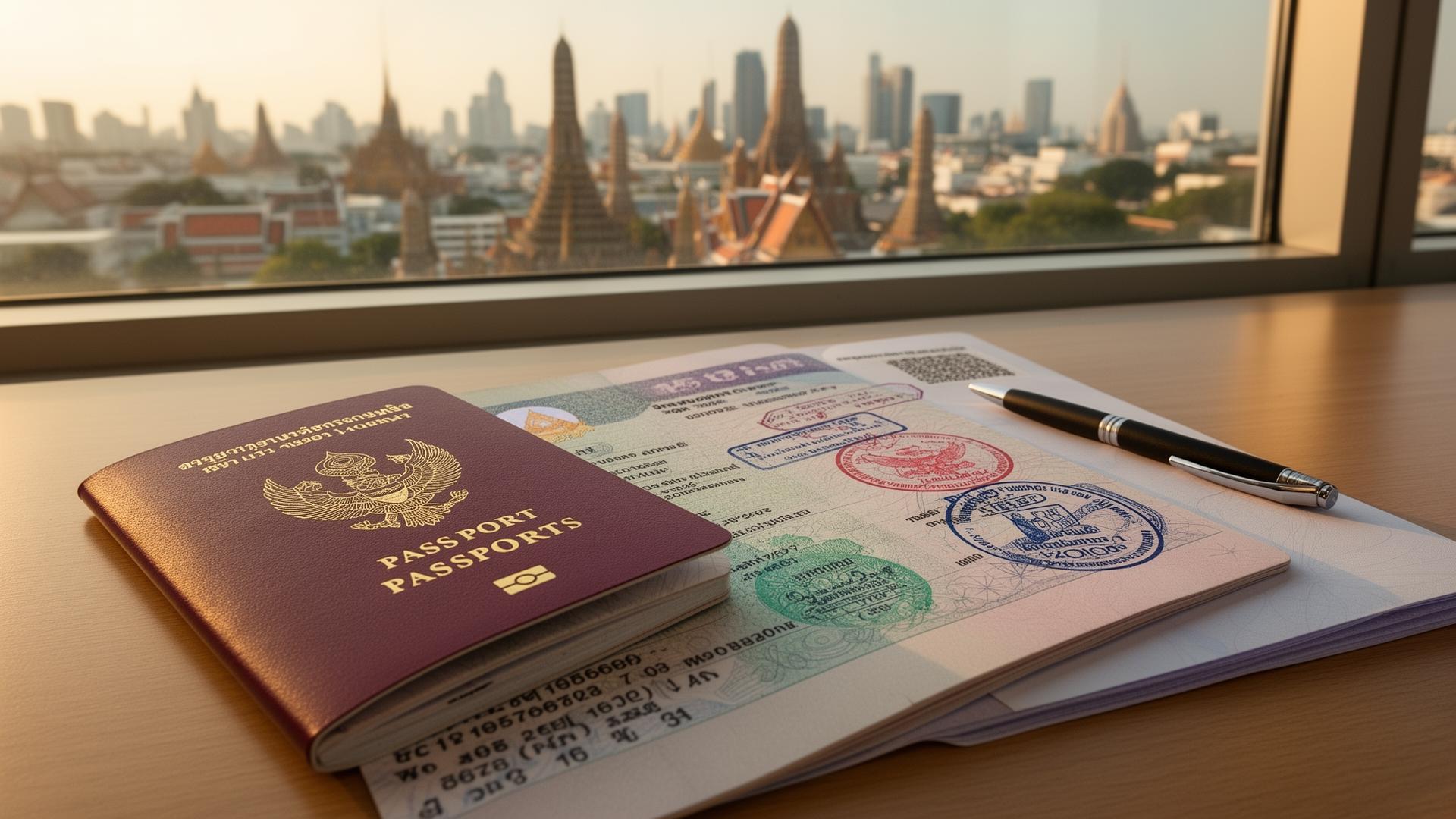
Non-O Spousal Visa
The residency visa for the foreign spouse of a Thai national
Non-Immigrant O (Marriage / Spouse of Thai) Visa — the complete 2026 guide
The Non-Immigrant O visa for marriage to a Thai national is one of the most popular long-stay routes for foreigners with Thai families. It is issued under the same Non-O category as retirement, family-visit, and dependent visas, but its extension rules are specific to spouses of Thai citizens. Note the terminology: there is no separate 'marriage visa' as a formal category — the correct name is Non-Immigrant O (based on marriage). It is not to be confused with getting married in Thailand, which is a separate legal process at your local district office; see /marriage-visa for that.
The visa runs on a 90-day initial stamp obtained at a Thai embassy in your home country (or occasionally in Vientiane or Penang if you're already in Southeast Asia), followed by 1-year in-country extensions at Immigration. Financial requirements are strict: either 400,000 THB in a Thai bank account (in your name, seasoned for at least 2 months before extension, ideally continuously present through the year) OR 40,000 THB monthly income transferred into Thailand and evidenced by an embassy income letter or Thai bank statements. Failing to maintain either qualifier will refuse your annual extension. The spousal visa does NOT include work authorisation — if you want to work, you need a separate Non-B and work permit.
Extension procedures involve an Immigration officer visiting your registered marital home to verify you actually live with your Thai spouse. Photos of your home, joint utility bills, and neighbours' witness statements are typical. This home-visit rule catches out sham marriages routinely. You also do 90-day reporting like other long-stay visas. Renewal requires updated marriage certificate, house registration (Tabien Baan) showing you're registered at the shared address, financial evidence, and spouse-attendance at Immigration. Cross-link to /marriage-visa for the wedding-registration process, /retirement for the alternative Non-O path via age 50+, and /embassies for embassy income letter procedures.
Who qualifies
Foreign national legally married to a Thai citizen, holding a Thai marriage certificate, meeting the 400,000 THB bank deposit or 40,000 THB monthly income requirement.
Processing time
1–3 weeks embassy; extensions same-day in Thailand
Issued by: Thai Immigration Bureau
Government fees
Documents you'll need
- Thai marriage certificate (Khor. Ror. 3) — original + copy
- Thai spouse's national ID card (bat prachachon) — copy
- House registration (Tabien Baan) showing you're registered at spouse's address
- 400,000 THB Thai bank deposit (2+ months old) OR 40,000 THB/month income letter
- Passport valid at least 6 months
- Photos of you and spouse together at your registered home
- Spouse attends Immigration extension appointment
Application process, step by step
- 1
Register your marriage at a Thai district office
If you married outside Thailand, first register the foreign marriage certificate through a Thai embassy and the Thai Ministry of Foreign Affairs. If getting married in Thailand, both parties present their passport, Thai ID (spouse), and a certificate of freedom to marry from your embassy at any Amphoe (district office). Certificate issued same-day. See /marriage-visa for details.
- 2
Choose your financial qualifier
The 400,000 THB bank deposit route is more common. Deposit the money in a Thai bank account in your name at least 2 months before your extension appointment (Bangkok Bank, Kasikorn, and SCB are standard). The 40,000 THB monthly income route requires an income affidavit from your embassy (US, UK, Aus, Canada) OR verified salary transfers into a Thai bank account over the 12 months prior.
- 3
Get the initial 90-day Non-O visa
Apply at a Thai embassy in your home country or a regional embassy. Present the marriage certificate, passport, spouse's Thai ID copy, house registration, financial evidence, and application form. Cost 2,000 THB single-entry. Alternatively, you can convert from a tourist visa to Non-O in-country at Chaeng Wattana if you're already in Thailand — bring the same documents plus 2,000 THB.
- 4
Book the 1-year extension appointment
Within 30 days before your 90-day stamp expires, book at Chaeng Wattana or your provincial Immigration office. Your Thai spouse must attend with you. Bring the full document set: marriage certificate original + copies, spouse's ID and house registration, financial evidence (bank statements 12 months if using 400k route), TM.7 form, photos, 1,900 THB.
- 5
Undergo the home visit
An Immigration officer visits your registered marital home within 30 days of your extension application, unannounced but during business hours. Have joint photos, utility bills in your name, and clothes/personal items obviously belonging to both of you. Neighbours may be asked to confirm you actually live there. Sham-marriage cases fail here.
- 6
Do 90-day reporting throughout the year
Like all long-stay visas, Non-O holders must file a 90-day report at Immigration or online at tm47.immigration.go.th. Miss a report and you're fined 2,000 THB per infraction. Set calendar reminders for each 90-day anniversary. This obligation continues until you either upgrade to Permanent Residency or leave permanently.
Advantages
- Cheaper than LTR or Privilege — no upfront investment
- Includes access to your Thai spouse's family and community
- Base for future Permanent Residency application (5 years continuous)
- Financially flexible: either 400k bank deposit OR income route
- Non-Immigrant O has no upper age limit (unlike retirement variant)
Drawbacks
- No work authorisation — need separate Non-B for employment
- Home-visit rule is intrusive; some couples find it uncomfortable
- Annual renewal is labour-intensive vs LTR's once-per-year reporting
- Divorce or spousal death immediately invalidates the visa
- 400,000 THB tied up in Thai bank account limits liquidity
Long-term expat health cover — SafetyWing Remote Health
Cover that meets LTR-visa insurance requirements (USD 50k+ medical). Renewable annually, portable across countries.
Affiliate link — we may earn a commission. Does not affect our recommendations.Learn more
Move funds to Thailand for your Non-O application
Wise uses the real exchange rate and charges a transparent flat fee. Popular with expats over Western Union / bank SWIFT.
Affiliate link — we may earn a commission. Does not affect our recommendations.Learn more
You Might Also Like
Sources & official references
- Thai Immigration Bureau — Non-O extension procedures, home-visit rules, and 90-day reporting.
- Ministry of Foreign Affairs — Consular — Foreign marriage certificate authentication and Thai-side registration.
- Department of Provincial Administration (DOPA) — Marriage registration at Amphoe (district) offices; house registration rules.
UK expat living in Bangkok since 2019 — LTR-visa holder since the 2023 Highly-Skilled Professional launch and previously an ex-BBC South-East-Asia stringer. Covers every visa category, work-permit process, tax reform, and long-stay pathway on the site. Files original walkthroughs from the actual Chaeng Wattana and BOI counters, and cross-checks every fee against the source ministry.
Last updated: 2026-07-01