Money & Currency Exchange
Get the best rates and avoid common money traps
Managing Money in Thailand
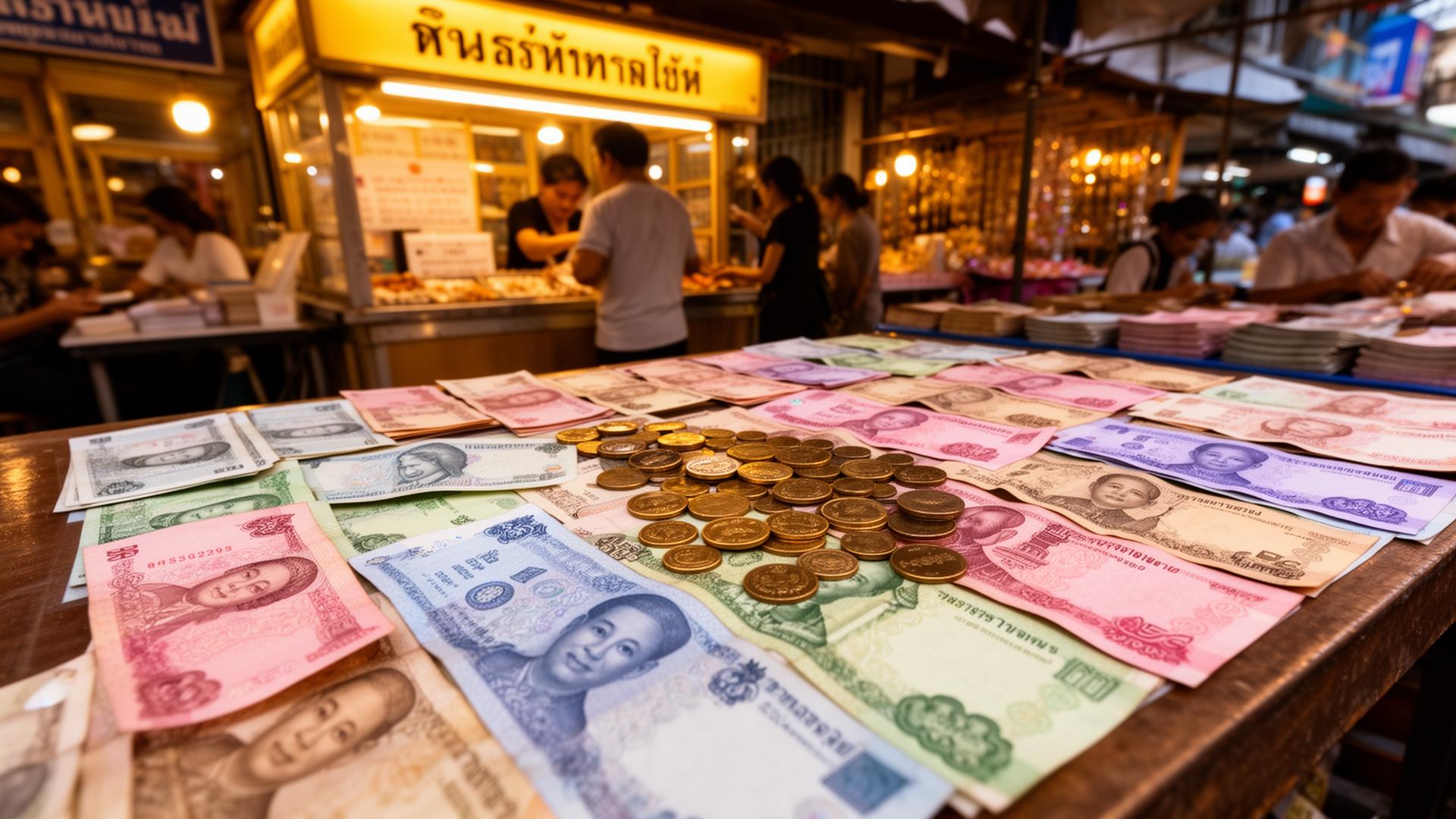
The Thai Baht (THB, ฿) is the sole legal currency in Thailand, and understanding how money works here can save you hundreds of dollars during your stay. Thailand operates as a surprisingly dual economy when it comes to payments: street food stalls, taxis, markets, and small shops remain almost entirely cash-based, while malls, restaurants, and modern businesses have enthusiastically adopted QR-code payments through PromptPay — Thailand's national instant payment system that has made the country one of the most cashless-advanced in Southeast Asia. As a visitor, you'll need to navigate both worlds.
Where you exchange money matters enormously. Airport exchange booths at Suvarnabhumi offer notoriously poor rates — sometimes 5–8% worse than city center options. The gold standard for cash exchange is SuperRich (the green-signed original on Rajdamri Road, not to be confused with the orange-signed competitor), which consistently offers rates within 0.1–0.3% of the interbank mid-market rate for major currencies like USD, EUR, GBP, and JPY. Vasu Exchange on Sukhumvit Soi 7/1 and the exchange booths inside major BTS stations also offer competitive rates. Bangkok Bank and Kasikorn Bank branches give decent rates but charge a small commission. As a rule: never exchange at hotels, and bring crisp, undamaged bills — Thai exchangers routinely reject torn, marked, or older-series notes.
ATMs are everywhere in Bangkok, but they come with a sting: every Thai ATM charges a flat 220-baht fee per international withdrawal, on top of whatever your home bank charges. This makes it one of the most expensive ATM markets in the world for foreigners. The workaround is to withdraw the maximum amount (usually 20,000–30,000 baht depending on the bank) per transaction to minimize the per-baht fee. Aeon ATMs (found in most malls) offer a slightly higher limit. Be warned: when a Thai ATM asks if you want to be charged in your home currency ("Dynamic Currency Conversion"), always decline and choose Thai Baht — accepting the conversion means the ATM operator sets the rate, which is typically 3–5% worse. Consider opening a Wise (formerly TransferWise) multi-currency account before your trip; their Thai Baht transfers and card payments use the real exchange rate with a transparent fee of about 0.5%.
Currency
Thai Baht (฿)
ATM Fee
฿220
Cards Accepted
Most malls & restaurants
Best Rate For
USD, EUR, GBP
Money Tips
Never Exchange at the Airport
Airport exchange booths offer significantly worse rates. Only exchange a small amount for immediate transport and exchange the rest in the city.
Compare Rates Online First
Check XE.com or Google for the mid-market rate before exchanging so you know what a fair rate looks like.
ATM Withdrawal Tips
Thai ATMs charge ฿220 per withdrawal for foreign cards. Withdraw large amounts to minimize fees. Always decline the ATM's conversion offer.
Use Wise or Revolut Cards
Travel-friendly debit cards like Wise and Revolut offer near mid-market rates with low or zero fees at Thai ATMs.
Avoid Dynamic Currency Conversion
When paying by card, always choose to pay in Thai Baht (THB), not your home currency. DCC adds a 3-5% markup.
Mobile Payment Options
Many shops and restaurants accept PromptPay QR codes. Some accept Alipay and WeChat Pay. Cash is still king at street stalls.
Where to Exchange Money
SuperRich (Orange)
Widely considered the best exchange rate in Bangkok. Multiple branches across the city.
SuperRich (Green)
Sister company to SuperRich Orange. Rates are competitive and almost identical.
Vasu Exchange
Located near Nana BTS. Consistently good rates and long operating hours.
Bank Exchange Counters
Available everywhere but rates are typically 1-3% worse than dedicated exchange shops.
Airport Exchanges
Most expensive option. Only use for small emergency amounts on arrival.