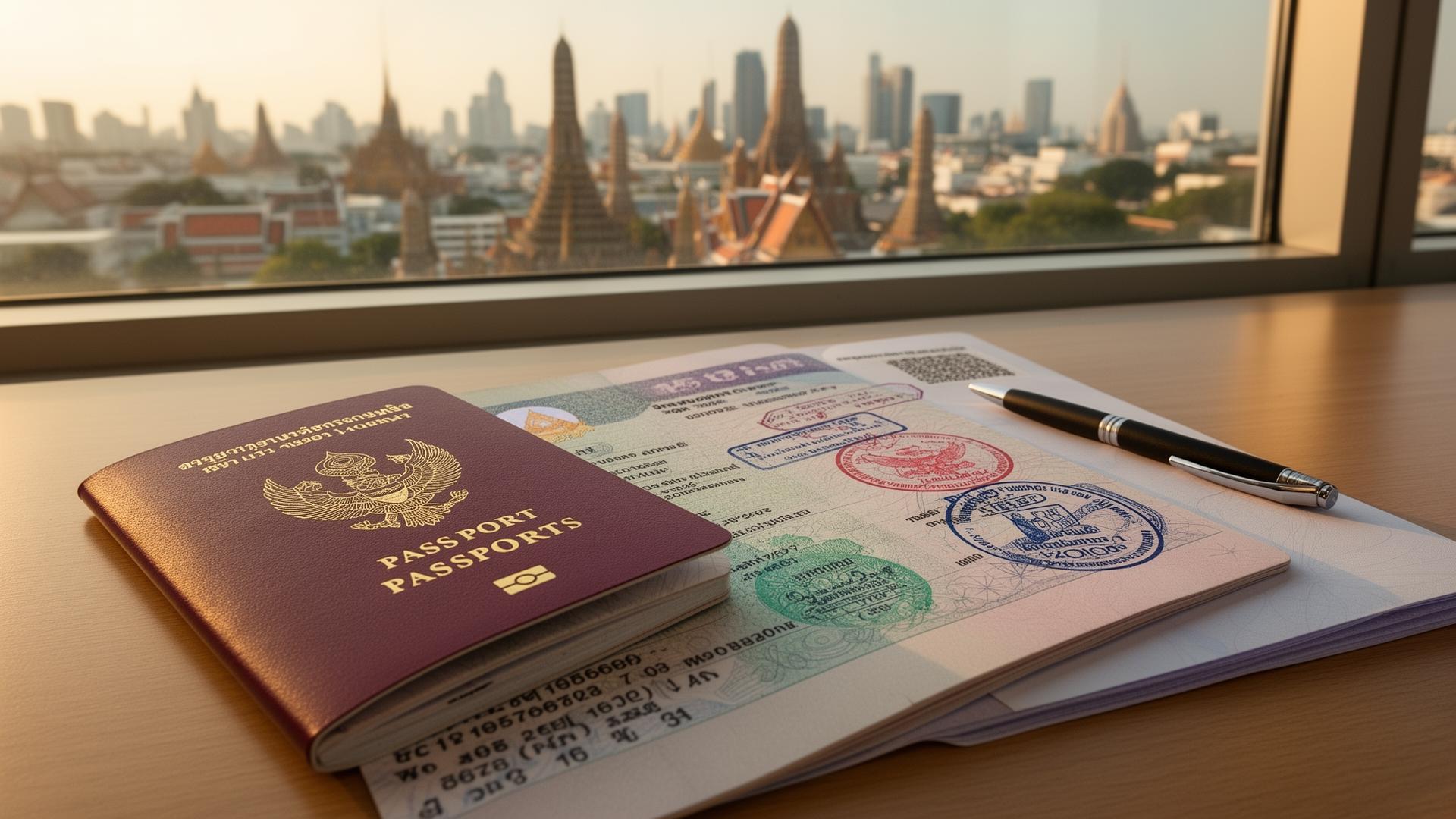
Thai Marriage Visa
Living legally in Thailand with your Thai spouse — the Non-O marriage visa, requirements, and the marriage-registration process
Marriage as a Long-Term Visa Path
The Non-Immigrant 'O' visa based on marriage to a Thai citizen is one of the most accessible long-stay paths to living in Thailand. The financial bar is 400,000 THB in a Thai bank account or a 40,000 THB monthly income — half the threshold of the retirement visa, and there's no minimum-age requirement. Once issued, the visa is renewed annually inside Thailand without leaving the country, and after several consecutive renewals it becomes the basis for permanent residency applications. The visa itself does not grant work rights — that requires a separate work permit application from a Thai employer, but the marriage visa makes the work-permit process noticeably smoother.
The process has two distinct stages. First you must be legally married, which means either registering the marriage at a Thai district office (amphur) or having a foreign marriage recognised in Thailand. Registering in Thailand is dramatically simpler: each partner produces their identification, the foreigner produces an 'Affirmation of Marital Status' from their home country's embassy (a 1–3 day process at the embassy), the embassy letter is translated and certified by the Thai Ministry of Foreign Affairs, and the marriage takes about half an hour at any amphur with two Thai witnesses. Total cost is usually under 2,000 THB plus the embassy fee. A foreign-issued marriage certificate can also be used but requires apostille, legalisation, translation, and certification — typically 3,000–10,000 THB and 2–4 weeks of paperwork.
Once the marriage is legally registered, you apply for the Non-O visa itself. The simplest path is to apply at a Thai embassy in your home country for an initial 90-day single-entry Non-O Marriage visa, then on arrival in Thailand convert that to a 1-year extension at your local immigration office before day 90. The required documents include the Thai marriage certificate, your Thai spouse's Thai ID and house registration book, recent photos showing both spouses at the marital home (interior, exterior, kitchen, bedroom), a Thai bank letter and statement showing the 400,000 THB has been held for at least 2 months, and the immigration forms TM.7 and TM.86. Annual renewals require the same package each year, plus 90-day address reports via the TM.47 form (which can be filed online).
Step 1 — Register Your Marriage in Thailand
- 1
Foreign partner obtains an 'Affirmation of Marital Status' (Statement of Single Status) from their home country's embassy in Bangkok. Cost varies (US $50, UK £75, Australia A$80, etc.).
- 2
Translate the embassy letter into Thai at a certified translator (200–500 THB). The translation must be notarised by the Thai Ministry of Foreign Affairs at Chaeng Watthana for final legal effect.
- 3
Both partners visit any district office (amphur) with the original passports, Thai ID, translated embassy letter, and two adult Thai witnesses (the amphur can usually provide them).
- 4
The registrar performs the marriage in ~30 minutes and issues the Thai marriage certificate (Khor Ror 2 and Khor Ror 3).
- 5
Obtain certified English translation of the marriage certificate (200–500 THB) — needed later for the Non-O visa application and for legal recognition in your home country.
Step 2 — Apply for the Non-O Marriage Visa
- 1
Confirm you meet the financial requirement: 400,000 THB in a Thai bank account in your name for 2+ months, OR 40,000 THB/month income verified by embassy or work permit.
- 2
Apply for a 90-day Non-O visa at a Thai embassy abroad (typical fee 2,000–7,000 THB). Some applicants choose to convert their current visa to Non-O at Thai immigration instead.
- 3
After arrival, gather documents (marriage cert, Thai spouse ID/house book, photos of marital home, bank statement, etc.) and submit a 1-year extension at your local immigration office before the 90 days expire.
- 4
Pay the 1,900 THB extension fee. Receive your 1-year extension stamp. Buy a re-entry permit (1,000 THB single, 3,800 THB multiple) if you plan to travel.
- 5
Renew annually inside Thailand. Maintain the 400,000 THB or income proof through every renewal. Report your address every 90 days (TM.47, online or in person).
Note on land ownership and divorce
Marriage to a Thai citizen does NOT grant foreigners the right to own land — that rule has no marriage exception. Any land bought during marriage with shared funds must be in the Thai spouse's name only, and the foreign spouse signs a declaration that the funds were the Thai spouse's personal property. Divorce immediately ends your right to extend the marriage visa; plan a transition (work permit, retirement visa, Elite, DTV) or be ready to leave.