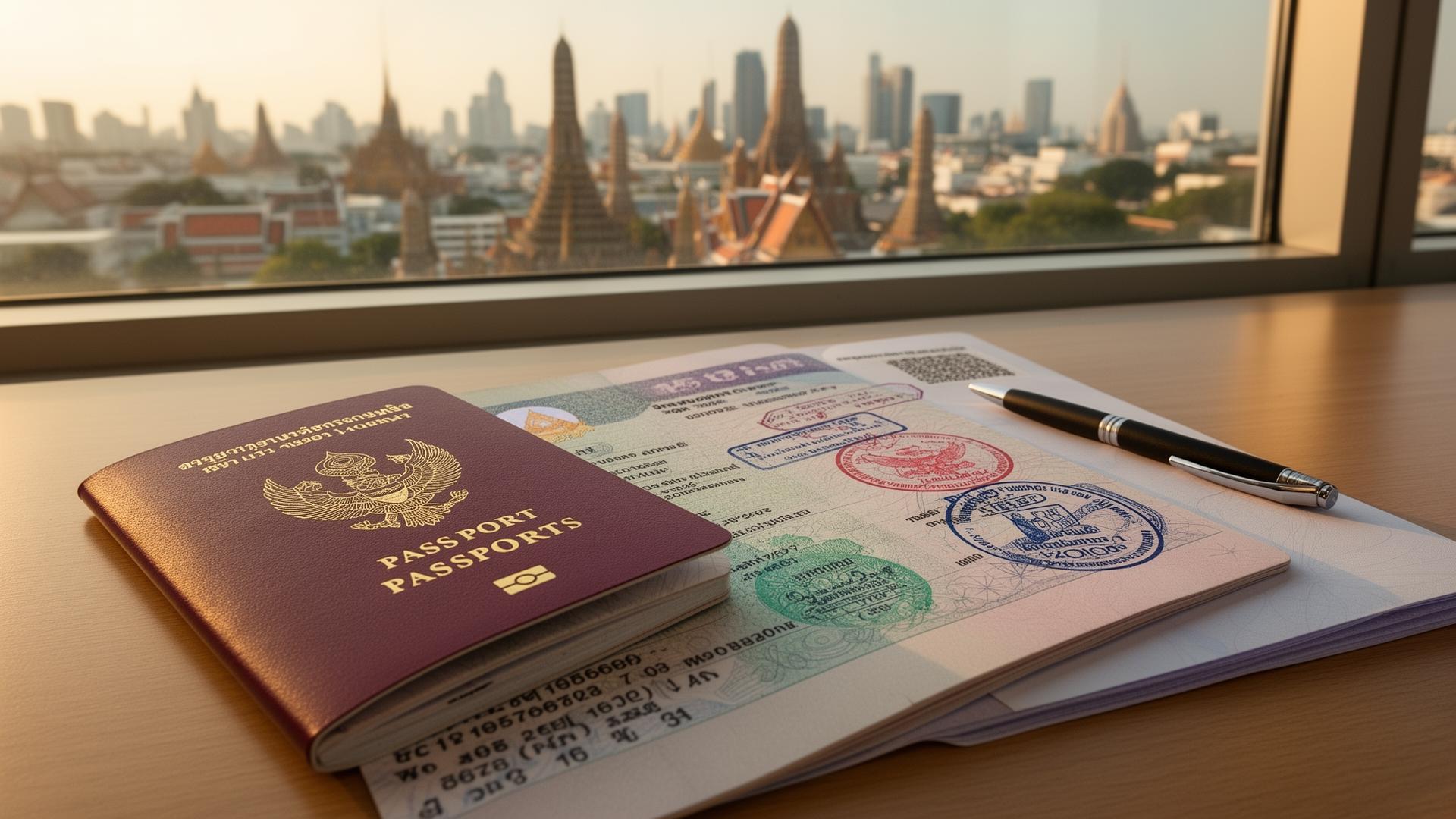
Destination Thailand Visa (DTV)
The 5-year digital nomad and soft-power visa launched in July 2024
Destination Thailand Visa — the complete 2026 guide
The Destination Thailand Visa (DTV) launched on 15 July 2024 to fill the gap between the tourist visa (60 days) and the LTR Visa (needing USD 80,000+ income). At 10,000 THB, valid for 5 years, allowing 180-day stays per entry and unlimited entries, the DTV is the most flexible single instrument the Thai government has ever offered digital nomads, freelancers, and long-stay soft-power participants. It is issued by the Ministry of Foreign Affairs at Thai embassies abroad or via the official e-visa portal, and it does not require you to enter Thailand within any specific window after issuance.
Eligibility splits into two broad tracks. Workcation applicants — the digital-nomad category — must show a foreign employment contract, a freelance-services contract with a foreign client, or ownership of a foreign company generating income. There is no minimum income requirement per se, but you must show approximately 500,000 THB in liquid funds (bank statements from the last 6 months). Soft-power applicants qualify by proof of enrolment in a recognised Thai activity: a Muay Thai training gym, a Thai cooking school, a Thai boxing or Muay Thai boxing camp, a private hospital or clinic providing treatment (medical tourism route), or a formal Thai arts and culture programme. Dependents (spouse and children under 20) can apply for 10,000 THB each.
The DTV does NOT authorise work for a Thai employer or with Thai clients. It is intentionally structured for foreign-income earners. Because the 180-day stay per entry is generous, and the 5-year validity outlasts any other multi-entry visa Thailand offers, expect the DTV to become the default long-term instrument for the digital-nomad demographic that used to bounce between tourist visas and visa runs. Extensions of an additional 180 days beyond the initial 180 are available at any Thai Immigration office for 10,000 THB. Cross-link to /digital-nomad-guide, /remote-work, and /cost-of-living for lifestyle context.
Who qualifies
Remote workers with a foreign employer or clients, freelancers, and participants in Thai soft-power activities (Muay Thai, Thai cooking, medical treatment, cultural courses).
Processing time
2–6 weeks at Thai embassies; sometimes days via e-visa
Issued by: Ministry of Foreign Affairs + Thai Immigration
Government fees
Documents you'll need
- Passport valid at least 6 months
- Bank statements showing ~500,000 THB (or equivalent) over 6 months
- Foreign employment contract OR freelance-services contract OR company registration (Workcation)
- OR proof of enrolment in Muay Thai gym / cooking school / hospital / cultural programme (Soft Power)
- Recent passport-sized photo (digital JPG)
- Cover letter explaining your intended activity in Thailand
- Proof of accommodation for the initial stay
Application process, step by step
- 1
Choose your track: Workcation or Soft Power
The two tracks require different supporting documents. Workcation applicants collect employer/client contracts and company registration certificates. Soft Power applicants secure enrolment letters from a Thai-side institution: Muay Thai gym, cooking school, private hospital treatment plan, or accredited cultural programme. Choose one track — you cannot apply under both.
- 2
Gather 6 months of bank statements
The DTV asks for approximately 500,000 THB (~14,500 USD) in liquid savings maintained for the last 6 months. Statements can be from any home-country bank or a Thai bank. Screenshots and unstamped PDFs are rejected — request official statements with the bank's letterhead or e-signature. Multiple accounts can be combined.
- 3
Submit online via e-visa portal or in person at embassy
The e-visa portal (thaievisa.go.th) is available in most home countries — the fastest option, often approving in 3–10 business days. Alternatively you can apply in person or by mail at a Thai embassy in your home country or in a nearby country. The fee is 10,000 THB (paid in local currency equivalent at the embassy) or online via card.
- 4
Receive the visa stamp / e-visa PDF
Embassies stamp your passport within 2–6 weeks. E-visa applicants receive a PDF valid for the 5-year period — print and carry it with your passport when you fly. First entry into Thailand starts the 180-day clock; subsequent entries reset the counter.
- 5
Extend at Thai Immigration (optional +180 days)
Before your 180-day stay expires, visit any Thai Immigration office (Chaeng Wattana in Bangkok, Muang Thong district) with your passport, DTV visa page, and 10,000 THB. Extensions grant an additional 180 days on top of your current stay — up to 360 days total per entry cycle. Bring proof of accommodation and a completed TM.7 form.
Advantages
- 5-year validity — longest multi-entry visa in Thailand's toolkit
- 180-day stay per entry, extendable +180 in-country
- Modest 500,000 THB liquid savings requirement (no annual income minimum)
- Covers both digital nomads and soft-power participants (Muay Thai, cooking, medical)
- Multi-entry — unlimited exits and re-entries
- Includes spouse and children as dependents
Drawbacks
- Cannot work for Thai employers or with Thai clients
- Not a path to permanent residency or citizenship
- 10,000 THB extension every 180 days can add up over long stays
- Embassy interpretation of soft-power documents varies — some reject Muay Thai enrolment letters they consider generic
- Recent implementation still evolving; expect rule tweaks over the next 12–24 months
Nomad travel + medical insurance — SafetyWing
Monthly rolling cover popular with digital nomads on DTV / tourist visas. USD 45-80/month.
Affiliate link — we may earn a commission. Does not affect our recommendations.Learn more
Move funds to Thailand for your DTV application
Wise uses the real exchange rate and charges a transparent flat fee. Popular with expats over Western Union / bank SWIFT.
Affiliate link — we may earn a commission. Does not affect our recommendations.Learn more
You Might Also Like
Sources & official references
- Thai e-Visa Portal — Official e-visa application system for DTV.
- Ministry of Foreign Affairs — DTV programme announcements and category clarifications.
- Thai Immigration Bureau — In-country 180-day extension procedures and offices.
UK expat living in Bangkok since 2019 — LTR-visa holder since the 2023 Highly-Skilled Professional launch and previously an ex-BBC South-East-Asia stringer. Covers every visa category, work-permit process, tax reform, and long-stay pathway on the site. Files original walkthroughs from the actual Chaeng Wattana and BOI counters, and cross-checks every fee against the source ministry.
Last updated: 2026-07