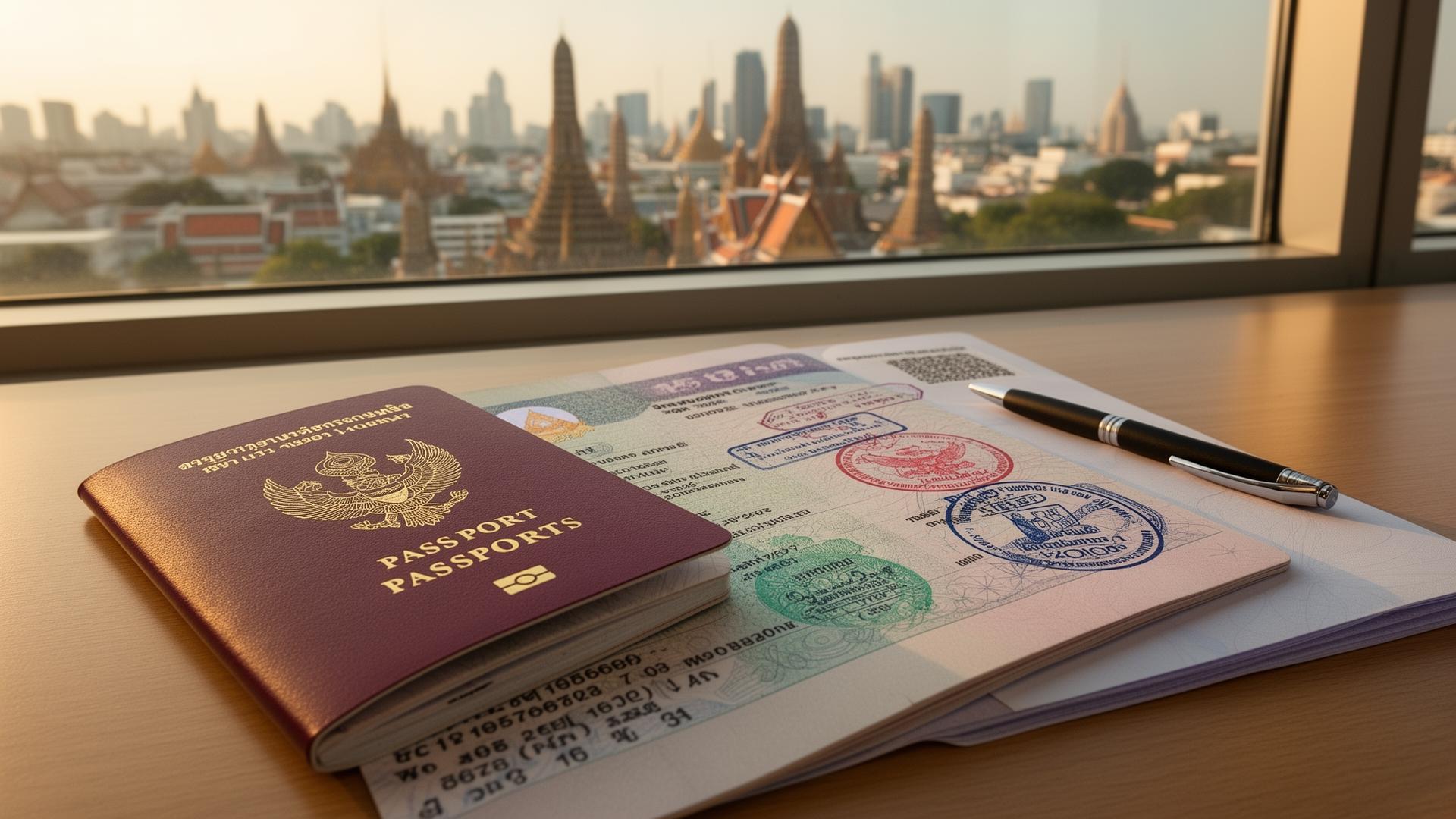
Non-Immigrant B (Business) Visa
The standard work visa for foreigners employed by Thai companies
Non-Immigrant B (Business) Visa — the complete 2026 guide
The Non-Immigrant B visa is the workhorse of Thailand's foreign-employment system. Any expat with a job at a Thai company — whether the company is Thai-owned, foreign-owned, or joint-venture — enters the country on a Non-B and pairs it with a work permit issued by the Ministry of Labour. It has existed for decades and represents the vast majority of foreigners legally working in Bangkok's offices, teaching posts, and factories. Unlike LTR or DTV, Non-B is employer-sponsored: your legal right to stay is tied to your job. Lose the job and you have 7 days to convert or leave.
Initial visa duration is a 90-day single-entry stamp from a Thai embassy in your home country (or Vientiane/Penang for third-country nationals), based on the employer's invitation letter, company registration, and financial statements. Once you're in Thailand and start work, the company files for your work permit within the first 30 days at the Ministry of Labour One-Stop Service Centre. Together with the work permit you extend the Non-B to a full year at Immigration. Renewals thereafter are annual, on the same day of your visa's issue date. Government fees are 2,000 THB for the visa (5,000 for multiple-entry), 3,000 THB per year for the work permit, plus 1,900 THB per extension.
Employer requirements are strict. The sponsoring Thai company must have registered capital of at least 2 million THB per foreign employee, plus 4 Thai employees per foreign employee (for the standard case; BOI-promoted companies get a lower ratio). Company tax filings must be current and paid VAT above certain thresholds. Certain professions are entirely reserved for Thai nationals under the Foreign Business Act — including construction labour, hairdressing, retail sales, and Thai-national ceremonial roles. English teaching, IT, and engineering are the most common Non-B routes; digital nomads without a Thai employer should look at DTV or LTR instead. See /work-permit-process for the parallel Ministry of Labour process, /jobs-bangkok for finding work, and /expat-taxes for the tax picture.
Who qualifies
Anyone with a job offer from a Thai company that meets employer-sponsorship criteria (registered capital, Thai-to-foreign employee ratio).
Processing time
1–3 weeks at Thai embassies; 5 working days for work-permit companion
Issued by: Ministry of Foreign Affairs (visa) + Ministry of Labour (work permit)
Government fees
Documents you'll need
- Employer invitation letter on Thai company letterhead
- Thai company registration certificate (Nor. Sor. 8/9)
- Company financial statements for the last audit period
- VAT registration (Phor. Por. 20) for tax-eligible companies
- Job offer letter, salary, and role description
- Applicant's CV, university transcript, and diploma copies
- Passport valid at least 6 months
- Recent passport-sized photo
Application process, step by step
- 1
Secure a job offer from a qualifying Thai employer
Your employer must be a Thai-registered company with capital of at least 2 million THB and (typically) 4 Thai employees for every foreign hire. BOI-promoted companies and IEAT-zone tenants have relaxed ratios. Get the offer in writing with role, salary, and start date; verify company registration on the DBD portal (dbd.go.th).
- 2
Collect employer documents
Your employer prepares an invitation letter, company registration (Nor. Sor. 8/9), latest audited financial statements, VAT registration certificate, and a list of current Thai vs foreign employees. The company's HR or accounting team should be familiar with the process — if they're not, offer to help by sharing the standard checklist from mfa.go.th.
- 3
Apply at a Thai embassy in your home country
Submit the employer packet with your passport, application form, photos, and CV. Some embassies require original documents; others accept scanned. Processing takes 1–3 weeks — some third-country embassies (Vientiane, Penang, KL) process faster and are useful if you're already in the region. The initial visa is a 90-day single-entry stamp.
- 4
Enter Thailand and start work
You have 90 days from entry to secure the work permit. Do not start work before the work permit is issued — Ministry of Labour officers occasionally do surprise inspections and fines are steep (100,000+ THB) for working without a permit. During this 90-day window register for the tax ID with the Revenue Department, open a Thai bank account, and locate a lawyer if you'll be handling company registrations.
- 5
Apply for the work permit
Your employer files at the Ministry of Labour One-Stop Service Centre (in Bangkok, the office is at Chaeng Wattana). Processing takes 5 working days once the file is complete. You collect the physical work permit book, which lists your employer, address, and role. Keep it with your passport during business hours; occasional inspection is possible. See /work-permit-process for the deep dive.
- 6
Extend the visa to 1 year at Immigration
With the work permit issued, apply at Chaeng Wattana Immigration to convert the 90-day stamp into a 1-year extension. You need the work permit, employer letter, salary evidence (recent payslips), Thai tax filing evidence, TM.7 form, one photo, and 1,900 THB. Extension processing is same-day for well-prepared files.
Advantages
- The standard, well-established path to legal employment in Thailand
- Includes work rights automatically (via companion work permit)
- Renewable annually as long as your job continues
- Base for future PR application after ~3 consecutive years of Non-B + work permit
- Access to Thai social security if enrolled by employer (SSO 33)
Drawbacks
- Tied to a specific employer — losing your job means losing your visa
- Employer paperwork is heavy; many Thai SMEs cannot meet 2M-THB-capital / 4-Thai-employees threshold
- 90-day reporting required — no exceptions
- Complex tax obligations, especially the 800k-THB annual salary rule for tax residency planning
- Work-permit inspections and Ministry of Labour audits are stressful
Long-term expat health cover — SafetyWing Remote Health
Cover that meets LTR-visa insurance requirements (USD 50k+ medical). Renewable annually, portable across countries.
Affiliate link — we may earn a commission. Does not affect our recommendations.Learn more
You Might Also Like
Sources & official references
- Ministry of Foreign Affairs — Non-B visa categories, embassy fees, and current documentary requirements.
- Ministry of Labour — Work permit rules, employer qualifications, and Thai-employee ratio calculations.
- Department of Employment — Restricted occupations list and current foreign-worker statistics.
- Thai Immigration Bureau — Extension procedures, 90-day reporting, and re-entry permit info.
UK expat living in Bangkok since 2019 — LTR-visa holder since the 2023 Highly-Skilled Professional launch and previously an ex-BBC South-East-Asia stringer. Covers every visa category, work-permit process, tax reform, and long-stay pathway on the site. Files original walkthroughs from the actual Chaeng Wattana and BOI counters, and cross-checks every fee against the source ministry.
Last updated: 2026-07